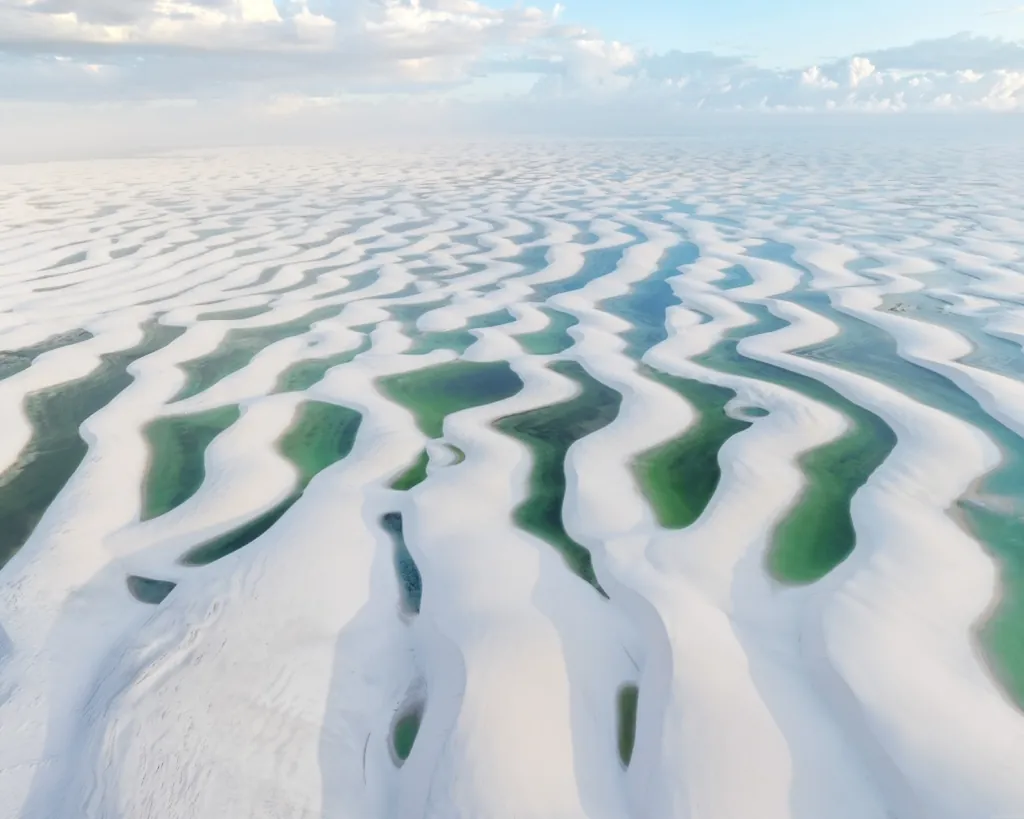
How the lagoons work
The Lençóis Maranhenses are 156,000 hectares of coastal dunes — the largest dune field in South America and a UNESCO World Heritage Site since 2024. The dunes reach 30 metres and are threaded with temporary lagoons that appear when it rains and vanish as sun and wind evaporate the water.
Rain falls mainly between January and June. The sand is impermeable enough to hold water between the dunes, and the water table rises. From June onwards, as the skies clear, the lagoons are full. From September they begin to drop. By December only the largest and the permanent ones remain.
Month by month
| Months | What to expect | Best for |
|---|---|---|
| January – February | Rains begin; lagoons filling; green on the dunes; few visitors | Silence, if you don't mind rain |
| March – May | Peak rains, in showers; lagoons already full by May | Overflowing lagoons in exchange for unsettled days |
| June – August | Full lagoons, clearing skies, wind starting. The classic Lençóis image | Everyone — high season |
| September – October | Steady sun, strong wind, lagoons still good and beginning to drop | Kitesurfing; lagoon and wind in the same day |
| November – December | Dry and windy; the larger and permanent lagoons remain; clear skies; empty village | Kite, rest, dune photography |
Temperatures through the year: 26 to 32 °C, warm water, afternoon wind. There is no cold in the Lençóis; there is wind.
Choose by what you want
- Full lagoons and photography — June to September. July has the strongest contrast between blue and white.
- Kitesurfing — September to November, 15 to 25 knots. Details on the kite page.
- Quiet and value — November to February. Fewer people, clean days, some lagoons.
- The walking crossing — June to September, when there is water in the lagoons along the way.
The classic outings
- Canto do Atins lagoons — the route for anyone staying in Atins: 4x4 to Canto, then on foot to the lagoons of the day.
- Lagoa Azul and Lagoa Bonita — depart from Barreirinhas; the park's most visited lagoons.
- Preguiças River — Vassouras, Mandacaru and Caburé by speedboat.
- Atins → Santo Amaro crossing — two or three days on foot, sleeping at Queimada dos Britos and Baixa Grande.
- Sunrise on the dunes — out before five, back for breakfast.
Simple rules for the park
- Go with a licensed driver or guide — it is required, and it is what makes the outing work.
- There is no infrastructure inside the park. Carry water and a hat, and bring your rubbish back.
- Prefer mineral sunscreen and go into the lagoons without excess product: it is the same water the village lives on.
- Drones require authorisation from ICMBio, the park authority.
- Walk on the dunes, not on the vegetation that holds them.